

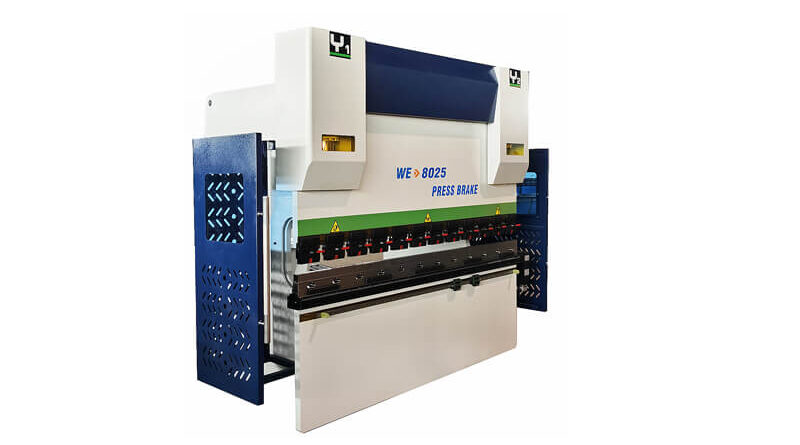
Sheet Metal Bending Machine: Types, Working Principles & Selection Guide
A sheet metal bending machine is used to form flat metal sheets or plates into precise angles, channels, boxes, profiles, and other three-dimensional shapes. In industrial sheet metal fabrication, bending machines are selected according to the material, sheet thickness, bending length, required force, production volume, part geometry, accuracy, and level of automation.
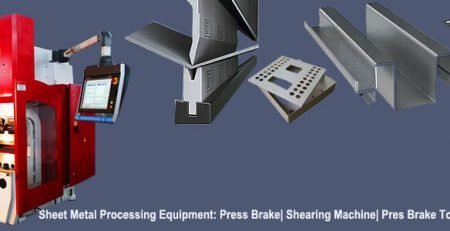
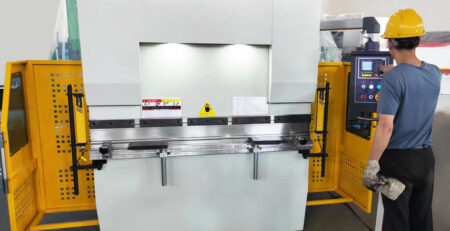
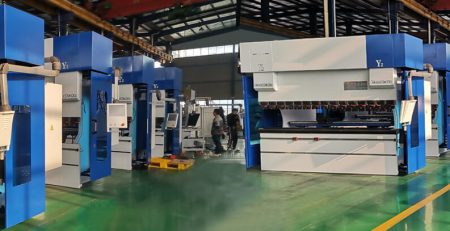
A press brake is one of the most widely used types of sheet metal bending machines. Modern CNC press brakes can combine programmable back gauges, precision tooling, automatic compensation, and multi-axis control for repeatable production.
This guide explains the main types of sheet metal bending machines, how they work, common bending methods, and the factors to consider when selecting a machine for industrial fabrication.
What Is a Sheet Metal Bending Machine?
A sheet metal bending machine applies controlled force to deform a flat metal workpiece into a specified angle or profile without removing material. The metal sheet bender machine is used in metal fabrication such as construction, automotive, and aluminum manufacturing, and for creating components like brackets, enclosures, and more.
The bending process normally involves:
- A machine frame and bending system
- A punch and die or other forming tooling
- A mechanism for applying bending force
- A system for positioning the workpiece
- A control system for setting or programming the bending operation
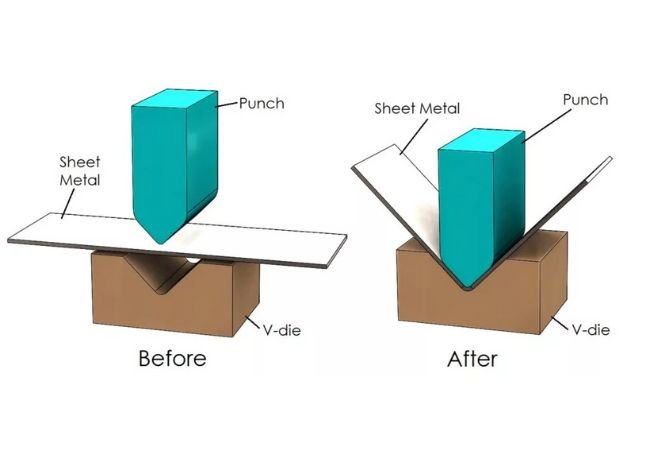
For press brake bending, the sheet is positioned between the punch and die. As the punch moves toward the die, the sheet deforms around the die opening and forms the required angle.
The final result depends on the material properties, sheet thickness, tooling geometry, bending force, bend radius, and bending method.
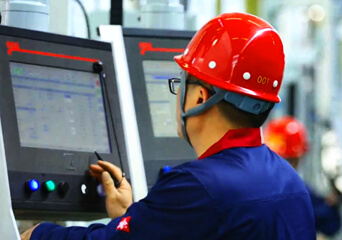
Sheet Metal Bending Machines Types
The Sheet metal bending machines include hydraulic sheet metal bending machines and CNC sheet metal bending machines.
Hydraulic Sheet Metal Bending Machine(Hydraulic Press Brake)
The machine is equipped with hydraulic electric control. It can adjust slider travels, inching, semi-automatic, and automatic operating.
The hydraulic system may experience and quick decline, working speed, quick return, and sudden stop during work in the process of up and down, etc.
CNC sheet metal bending machine (CNC Press Brake)
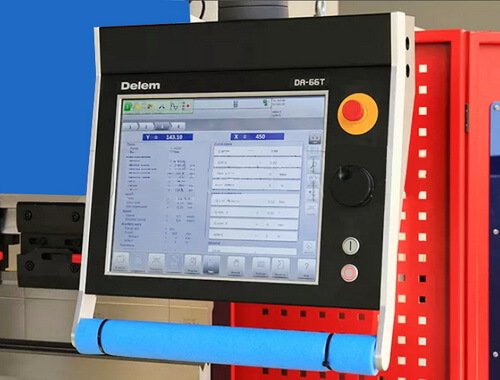
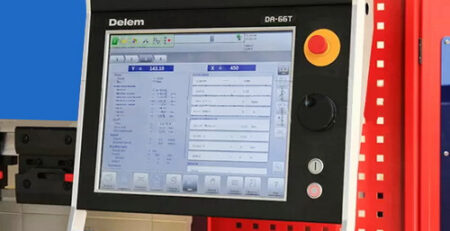
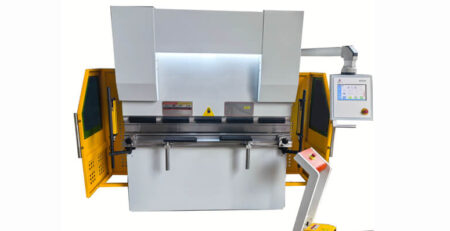
Automatic sheet metal bending machine with CNC controller DA66 for high precision & accuracy. and The automatic bending machine for sheet metal plates can be equipped with the crowning system.
- An automatic CNC crowning system for improving the sheet metal machines’ working precision.
- a servo-driven back gauge system for increased speed.
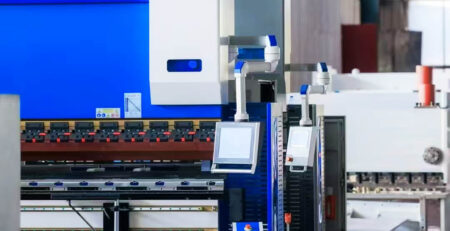
- a 3D graphical touch screen to simulate the bending sequence.
Automation & Software
Automatic sheet metal bending machine with CNC-controlled back gauge
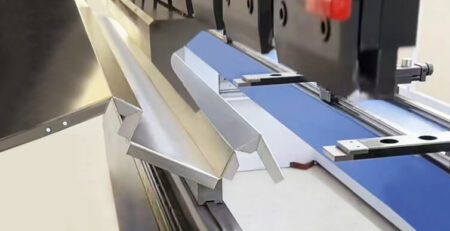
A back gauge is a component used with a CNC sheet metal bender machine to position workpieces for bending. It can be moved and positioned to allow press brakes to create a variety of complex bends.
- Ram stroke (Y) and back gauge(X, R, Z) are controlled by the CNC system.
- X controls the back gauge to move front and back.
- R controls the back gauge to move up and down.
- Z refers to back gauge fingers moving left and right.

- Crowning Systems: Under high pressure, the machine’s bed can actually bow slightly (deflection). A “Crowning” system uses wedges or hydraulic cylinders in the lower bed to push back upward, ensuring the bend angle is consistent across the entire length of the part.
Manual Press Brake
A manual press brake relies on manual operation and adjustment rather than a fully programmable CNC control system.
It can be suitable for small workshops, maintenance work, prototypes, and applications where production volume and automation requirements are relatively low.
How Does a Sheet Metal Bending Machine Work?
The basic bending process can be summarized as:
Workpiece positioning → Tool selection → Force application → Material deformation → Springback compensation → Finished bend
For a press brake, the punch pushes the sheet into or toward the die opening. The position of the back gauge determines where the bend is formed, while the CNC system can control the bending sequence and machine movement.
Several factors affect the final bending result:
- Material type and strength
- Sheet thickness
- Bend angle
- Inside bend radius
- Die opening
- Punch geometry
- Bending force
- Material springback
- Machine deflection
- Back-gauge accuracy
For CNC production, the machine can use programmed parameters to repeat the same bending sequence across multiple workpieces.
Main Components of a Press Brake Bending System
Although sheet metal bending machines have different designs, a modern press brake normally includes several key components.
Frame and Ram
The frame provides the structural support for the bending operation. The ram carries the upper tooling and moves toward the worktable during bending.
Hydraulic System
On a hydraulic press brake, the hydraulic system generates and controls the force required to move the ram.
Punch and Die
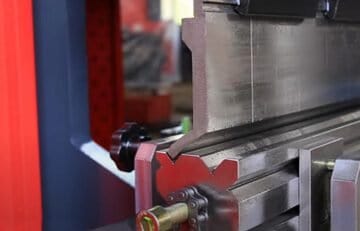
The punch and die form the sheet metal. Different tooling geometries are selected according to the required bend angle, radius, flange dimensions, material, and application.
CNC Back Gauge
The back gauge positions the workpiece before bending. Multi-axis back gauges can improve positioning flexibility for complex parts.
CNC Controller
A CNC controller stores bending programs and coordinates machine movements. Advanced controllers can assist with bend sequence programming, tooling selection, angle calculation, and other production functions.
Crowning or Compensation System
Long press brakes can experience frame and table deflection under high bending loads. A crowning system compensates for this deflection to help maintain consistent bending angles across the workpiece.
Sheet metal bending methods and techniques
Sheet metal Bending involves the deformation of a metal part. The deformation changes in shape from a smooth plate to a V shape. The sheet metal bending processes consist of sheet metal bending types in different shapes, applications, and advantages.
Air Bending:
Air bending is the most common and versatile method of bending sheet metal on a press brake. Instead of forcing the metal fully into the die cavity, the metal is formed by pressing a punch tip into the die opening, allowing the material to flex and form the desired angle. This method is called “air bending” because there is always a gap (or “air”) between the bottom of the punch tip and the bottom of the V-die cavity. Air bending is the preferred method in modern fabrication due to its flexibility and efficiency.
Bottom Bending:
Sheet metal to the bottom of the die can create a sharp bend. As it overcomes the spring back problem by punch and die force, it provides precise bends in sheet metal work.
Bottom bending is used to produce electrical enclosures, medical equipment, and intricate components.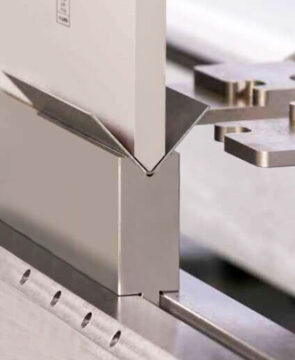
Coining:
Provides highly accurate, tightly controlled bends, suitable for intricate designs.
Complex forming complex parts with hemming and flattening dies
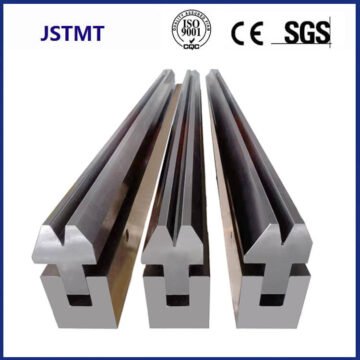
Hemming dies: Hemming dies are specialized press brake tools used to flatten a pre-bent acute angle (typically 30 or less) to create a closed, smooth, and safe 180 edge, known as a hem.

Roll Bending:
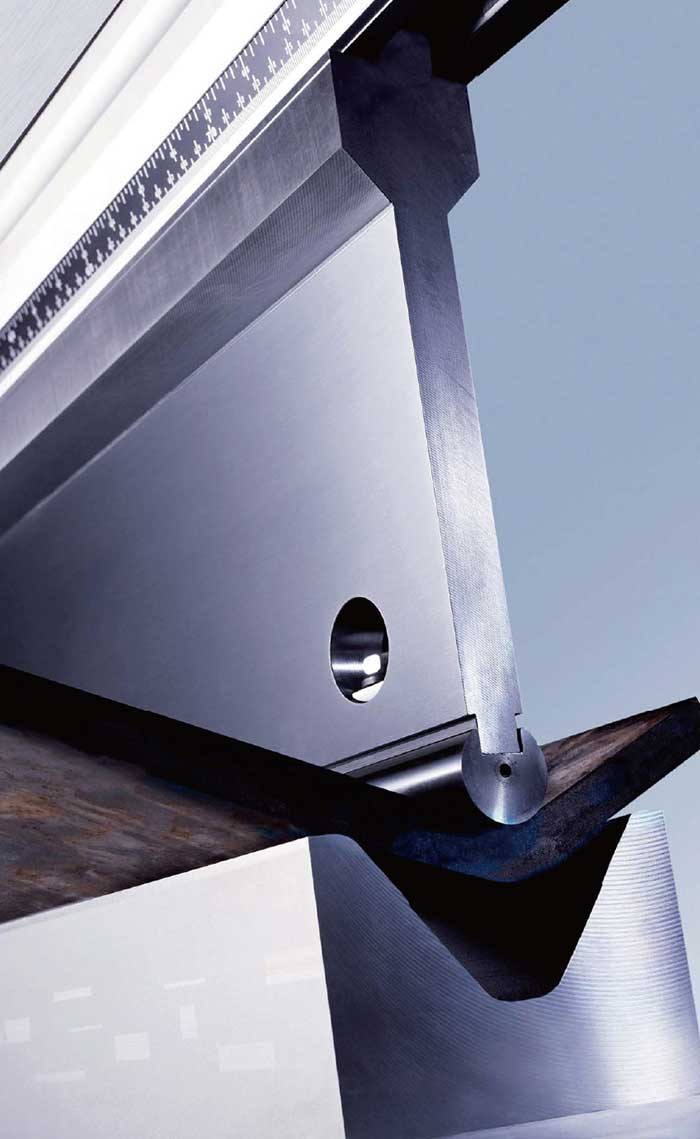
Roll bending uses a roller to curve the metal sheet for curved or cylindrical shapes. It is used in the production of pipes, tubes, and structural components.
Roller sets are central in the use of this method capable of creating different cross-section profiles with numerous curves. Roll bending offers high efficiency and accuracy for consistent bends.
Box Bending:
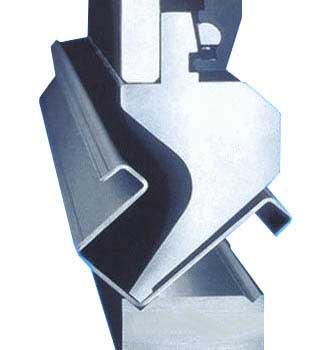
The V bends are often used in the punch and die with a V opening. It controls bending angles and is applied in the automotive, aerospace, and electronics industries.
How to calculate the Bend Allowance and Bend Deduction
You can calculate the Bend Allowance (BA) and Bend Deduction (BD) using formulas that incorporate the K-Factor, material thickness, and the bend radius. These calculations are mainly for determining the precise flat length of sheet metal needed to achieve a finished part with correct dimensions.
1. Calculating Bend Allowance (BA)
The sheet metal bending machine Bend Allowance (BA) is the length of material consumed by the bend itself, measured along the neutral axis (the internal line that neither stretches nor compresses). This length is added to the flat lengths of the two legs.
The standard formula for Bend Allowance is:
BA=2π(R+K⋅T)(A/360A)
2. Calculating Bend Deduction (BD)
The Bend Deduction (BD) is the amount that must be subtracted from the sum of the outer flange lengths (or setbacks) to get the correct flat pattern length. This is often the preferred value for CAD and CAM software.
BD=(2⋅OL)−BA
3. Understanding the K-Factor
The K-Factor () is a ratio used to determine the location of the neutral axis—the point within the material thickness that neither stretches nor compresses during bending. Its role is critical because it directly influences the BA and BD calculations.
- K=Distance from Inside Face to Neutral Axis / Material Thickness (T)
- The K-Factor is typically between 0.3 and 0.5.
- A common industry standard for air bending when the inside radius (R) is close to the material thickness (T) is K=0.44.
Why it matters:
The true K-Factor is affected by the material’s hardness, the bending method (air bending vs. bottoming), and the ratio of R to T. Using the wrong K-Factor is the single largest source of error in sheet metal layout.
Benefits of sheet metal bending
- Increased Accuracy: Given the precise determination of the k-factors and bend allowance.
- Increased Productivity: The bending processes require less tooling and can support automation.
- Less Secondary Procedures: The bending process does not require secondary processes for completion such as cutting.
- Low Tooling Cost: Employ simple tooling to undertake the bending processes resulting in an overall low cost.
- Reduce Parts Usage: Bending allows you to furnish a single piece into a desired shape without having to employ many pieces in an assembly.
If you want to know how the sheet metal bending machine works or how to automatically position the back gauges, calculate the tonnage force, compensation, custom tooling for complex parts, you can contact us for our engineers with 10 experience for free.
Sheet Metal Bending Machine vs Press Brake
The terms sheet metal bending machine and press brake are sometimes used interchangeably, but they are not always identical.
“Sheet metal bending machine” is a broader description covering equipment used to form sheet metal through bending.
A press brake is a specific type of bending machine that uses a punch and die to create bends.
Other bending equipment, such as roll bending machines and panel benders, uses different forming principles.
For industrial fabrication, press brakes are especially common when the required parts contain straight, controlled bends and repeatable angles.
Sheet Metal Bending Accuracy: What Affects the Result?
Machine accuracy is only one part of the final bending result.
Consistent bending also depends on:
- Material thickness consistency
- Material strength
- Tooling condition
- Correct punch and die selection
- Back-gauge positioning
- Machine deflection
- Crowning compensation
- Springback
- Correct bending parameters
For CNC production, the control system can help manage many of these variables, but correct machine configuration and tooling remain essential.
How JSTMT Configures Sheet Metal Bending Solutions
JSTMT supplies press brake machines and compatible tooling for industrial sheet metal fabrication.
Machine configuration can be selected according to:
- Material and thickness
- Required bending length
- Required tonnage
- Production volume
- Part geometry
- CNC control requirements
- Back-gauge configuration
- Crowning requirements
- Tooling system
JSTMT also supplies press brake tooling for different machine standards and custom bending applications.
For a machine recommendation, the most useful information is the material, maximum thickness, maximum bending length, typical part dimensions, required bend angles, and expected production volume.
Frequently Asked Questions
What is a sheet metal bending machine?
A sheet metal bending machine forms flat metal sheets or plates into angles and profiles by applying controlled force. A press brake is one of the most common types of sheet metal bending machine used for industrial fabrication.
Is a press brake a sheet metal bending machine?
Yes. A press brake is a type of sheet metal bending machine that normally uses a punch and die to form controlled bends in sheet metal or plate.
What type of sheet metal bending machine is suitable for production?
The appropriate machine depends on production volume, material, thickness, bending length, part complexity, accuracy requirements, and desired automation. CNC press brakes are commonly selected when multiple bending operations and repeatable production are required.
How much tonnage does a sheet metal bending machine need?
Required tonnage depends on material strength, thickness, bending length, die opening, bend radius, and bending method. Sheet thickness alone is not enough to determine the required machine capacity.
What is the difference between NC and CNC sheet metal bending machines?
NC machines generally provide simpler numerical control and are suitable for relatively repetitive bending work. CNC machines offer greater programmability, multi-axis control, and flexibility for complex or varied production.
What tooling is used with a sheet metal bending machine?
Press brake bending commonly uses matched punches and dies. Tool geometry and dimensions should be selected according to material thickness, bend angle, inside radius, flange dimensions, machine capacity, and the required bending profile.
Can a sheet metal bending machine bend stainless steel and aluminum?
Yes. Many press brakes can bend stainless steel, aluminum, mild steel, and other sheet materials, provided the machine capacity and tooling are correctly selected for the material and thickness.
How can bending accuracy be improved?
Consistent results require appropriate machine capacity, accurate back-gauge positioning, suitable punch and die tooling, correct bending parameters, compensation for machine deflection, and consideration of material springback.
Sheet Metal Bending Resources
For more detailed engineering information, explore the related JSTMT resources on:
- CNC press brake programming
- NC vs CNC press brakes
- Press brake tonnage
- Press brake tooling
- Press brake back gauges
- Bending machine compensation
Need help selecting a sheet metal bending machine for a specific application?
Request a Quote with your material, thickness, bending length, and production requirements. JSTMT can recommend a suitable press brake configuration and compatible tooling for your application.

Comment (1)
[…] is air bending on a press brake? Air bending is a process that uses a press brake to create an angle in a flat sheet of metal. It’s only […]