

Physics of Press Brake Springback Precision
The Physics of press brake Springback: Why Your Bend Angle Drifts Across Batch Runs
Every press brake operator has faced the “ghost in the machine”: you set your CNC program for a perfect 90-degree bend, the first ten parts are flawless, but the next batch of the same material suddenly pops back to 91.5 degrees. This isn’t a machine malfunction—it is a fundamental battle against the Physics of Springback. To master precision, we must look beyond the controller and understand the elastic-plastic behavior of the metal itself.
1. The Core Mechanic: Elastic Recovery vs. Plastic Deformation
To master precision, an operator must understand that bending is a tug-of-war between two mechanical states. When the press brake ram descends into the die, the metal undergoes two distinct types of deformation simultaneously:
- Plastic Deformation: This is the permanent shape change where the molecular structure of the steel is rearranged.
- Elastic Deformation: Metal acts like a stiff spring; it stores a portion of the energy applied by the ram.
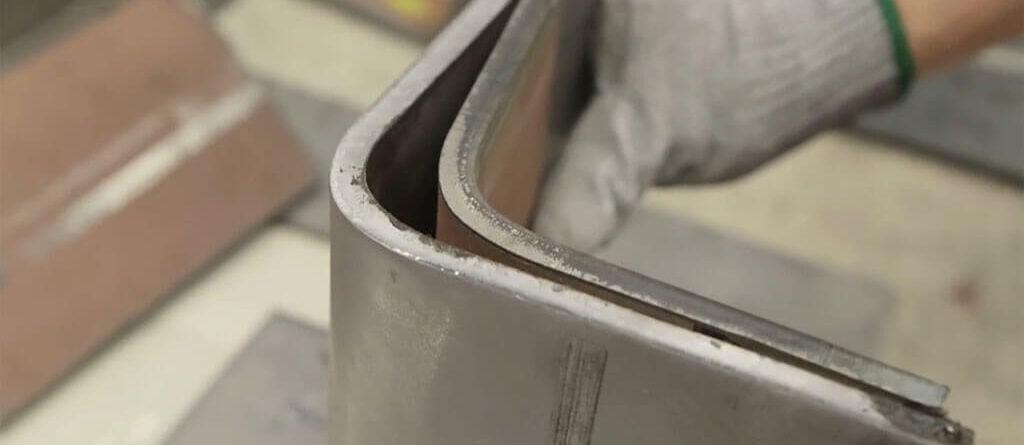
When you bend sheet metal on a press brake, the metal does not stay exactly in the shape of the punch/die after the tool is removed. Instead, it slightly “springs back” toward its original shape. This is called springback in sheet metal.
The Fiber Physics of the Bend
When we bend a sheet, we are essentially stretching and compressing the material’s internal structure. The metal fibers on the outer radius undergo intense tensile stress (stretching), while the fibers on the inner radius experience compression (squeezing).
Between these two layers lies the “Neutral Axis,” which theoretically remains unstressed. To create a permanent, repeatable shape, the press brake ram must push the material past its Yield Point and deep into the Plastic Zone.
Why “Springback” happens
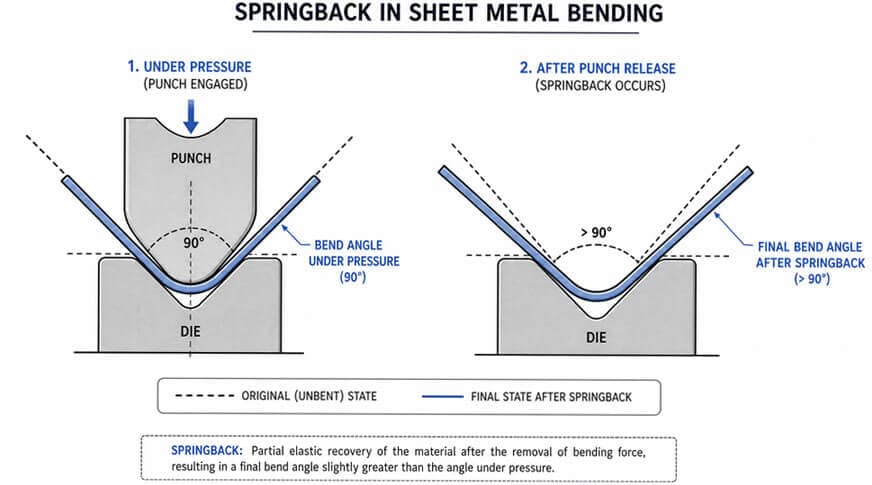
Metal is fundamentally an elastic medium. Even when you achieve successful plastic deformation, a percentage of the internal stress remains trapped in the Elastic Zone.
When the return stroke begins and the punch retracts, this stored elastic energy is “unloaded”. This causes the part to “spring back” or open slightly toward its original flat state. This physical reality is why the final bend angle is always slightly wider than the physical angle of the punch under full load.
Failure to account for this recovery leads to inconsistent angles, especially when tooling condition or material yield strength varies between batch runs. Maintaining a stable environment—from a calibrated control valve to high-grade 42CrMo tools—is the only way to maintain proper control over this natural physical phenomenon.
2. The “Invisible” Variables Affecting Your Batch Consistency
Why does springback change when the material thickness and program remain the same? The answer lies in three critical factors:
A. Yield Strength Fluctuations (The Mill Factor)
Materials are sold within a range of specifications, not an exact point. For instance, 304 Stainless Steel might have a yield strength ranging from 205 to 310 MPa depending on the heat number from the mill.
- Higher Yield Strength = More elastic energy stored = Greater Springback.
- This is why parts from different “batches” or “heats” of steel require recalibration, even if the gauge is identical.
B. Grain Direction (Anisotropy)
Sheet metal is rolled at the mill, creating a “grain” (molecular orientation) similar to wood.
- Bending Across the Grain (Transverse): The material is stiffer and stronger; springback is usually lower, but there is a higher risk of cracking.
- Bending With the Grain (Longitudinal): The material is more ductile; springback is significantly higher.
- The Batch Trap: If your nesting software rotates parts to save material, you will get different angles in the same batch because the grain orientation relative to the bend line has changed.
C. The R/t Ratio (Radius to Material Thickness)
The relationship between the internal bend radius (R) and the material thickness (t) is the primary predictor of springback volume.
- A large radius on a thin sheet (high R/t ratio) creates a massive elastic zone relative to the plastic zone, leading to huge springback (sometimes 10 degrees or more).
- A small, sharp radius concentrates the plastic deformation, minimizing the elastic recovery.(e.g., 2.05mm vs 1.95mm)
3. Calculating the “Real” Angle
The formula for the springback factor (K) is often expressed as:
K=αf/αi (Where αf is the final angle and αi is the angle under pressure)
Springback angle=Bend angle before unloading−Final bend angle after unloading
For common mild steel, springback is usually 0.5° to 1.5°. For stainless steel, it can jump to 3° to 5°. If you are bending high-tensile materials like Hardox, you may need to overbend by as much as 10° to 15°.
📊Springback Table (Approximate, Degrees)
| Material | 1 mm | 2 mm | 3 mm | 5 mm |
| Mild Steel (A36 / CRS) | 1°–2° | 1°–1.5° | 0.5°–1° | 0.5° |
| Stainless Steel (304) | 2°–4° | 2°–3° | 1.5°–2° | 1°–1.5° |
| Aluminum (5052-H32) | 3°–5° | 2°–4° | 2°–3° | 1.5°–2.5° |
| Aluminum (6061-T6) | 5°–8° | 4°–6° | 3°–5° | 2°–4° |
| High-Strength Steel | 3°–6° | 2°–5° | 2°–4° | 1.5°–3° |
4. How to Compensate for Springback
To defeat springback, JSTMT recommends 5 technical engineering Solutions for Inconsistent Angles.
- CNC crowning Compensation: Modern controllers (like Delem DA-66T or ESA) use database-driven springback tables.Mechanical or hydraulic crowning ensures the press brake ram delivers uniform pressure across the entire bed, preventing “canoe-shaped” parts where the center angle differs from the ends.
- Real-Time Compensation:The most effective method is Laser Angle Measurement, which measures the springback in real-time during the stroke and re-hits the part to correct it.
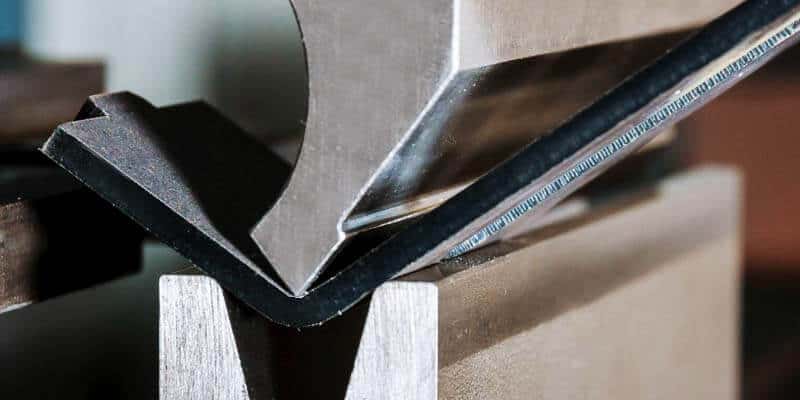
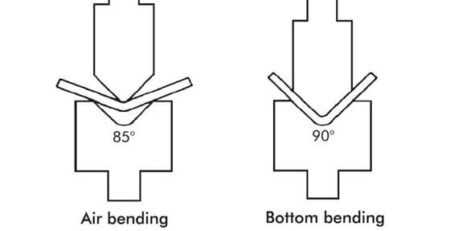
- Overbending the Part : Bend slightly past the desired angle so that springback brings it back to the target.Using an 88-degree or 85-degree punch instead of a 90-degree punch provides the physical “room” needed to push the material past the target angle to account for the return.
- Bottoming vs. Air Bending: While Air Bending is versatile, Bottoming (pressing the punch into the die seat) significantly reduces press brake springback by “setting” the metal at the bottom of the stroke. Note: This requires much higher tonnage and specific tooling durability.
- Dwell Time: Increasing the “dwell time” (holding the punch at the bottom of the stroke for 1-2 seconds) allows the metal molecules to “relax” into the new shape, slightly reducing the elastic snap-back.
| Solution | Technical Mechanism | Operational Benefit |
| 1. CNC Dynamic Compensation | Modern controllers (like Delem DA-66T or ESA) utilize database-driven springback tables to automatically adjust depth. | Automates the calculation of the bend angle, reducing the need for manual trial-and-error. |
| 2. Crowning & Pressure Uniformity | Mechanical or hydraulic crowning ensures the press brake ram delivers uniform pressure across the entire bed length. | Prevents “canoe-shaped” parts where the center angle differs from the ends, ensuring linear consistency. |
| 3. Real-Time Measurement | The use of Laser Angle Measurement systems calculates actual springback during the stroke and triggers a “re-hit” for correction. | The most effective method for high-precision jobs, providing immediate feedback to the control valve. |
| 4. Overbending & Tooling Selection | Bending past the target angle (e.g., using an 88° or 85° punch) provides the physical room to account for the return stroke. | Accounts for the Physics of Springback by pushing material past its yield point into the desired final geometry. |
| 5. Dwell Time & Process Logic | Increasing “dwell time” (holding at the bottom for 1–2 seconds) allows metal molecules to “relax” into the new shape. | Reduces the elastic “snap-back” effect, stabilizing the tooling condition and the final part’s accuracy. |
Conclusion: Turning Physics into a Competitive Advantage
Achieving a consistent bending angle across different batches of material requires more than just a high-end CNC controller. It demands a holistic approach: understanding the metallurgy of your sheet metal, respecting the grain direction in your nesting process, and, most importantly, utilizing precision-ground tooling that eliminates unnecessary variables.
By isolating the mechanical inconsistencies through the use of high-grade 42CrMo hardened dies, you allow your operators to focus on the only variable left—the material itself. Whether you are compensating for springback through air bending with 85-degree tools or seeking the stability of bottoming, remember that precision starts at the point of contact.
Master your precision. Reduce your scrap rate. Let JSTMT help you navigate the complexities of metal physics.
Looking for a specific solution?
[Talk to a JSTMT Engineer about Batch Consistency]





Leave a Reply