


Press Brake Back Gauge
The Ultimate Guide to Press Brake Back Gauge Systems: How X, R, Z Axes Impact Bending Efficiency
A precision-engineered press brake back gauge system is the secret to transforming a standard press brake into a high-speed automate positioning system . By mastering the coordination of X, R, and Z axes, manufacturers can eliminate manual setup errors and achieve unparalleled bending efficiency in complex metal fabrication.The adjustable Press Brake Back Gauge makes for an easy set-up of repeatable bends.
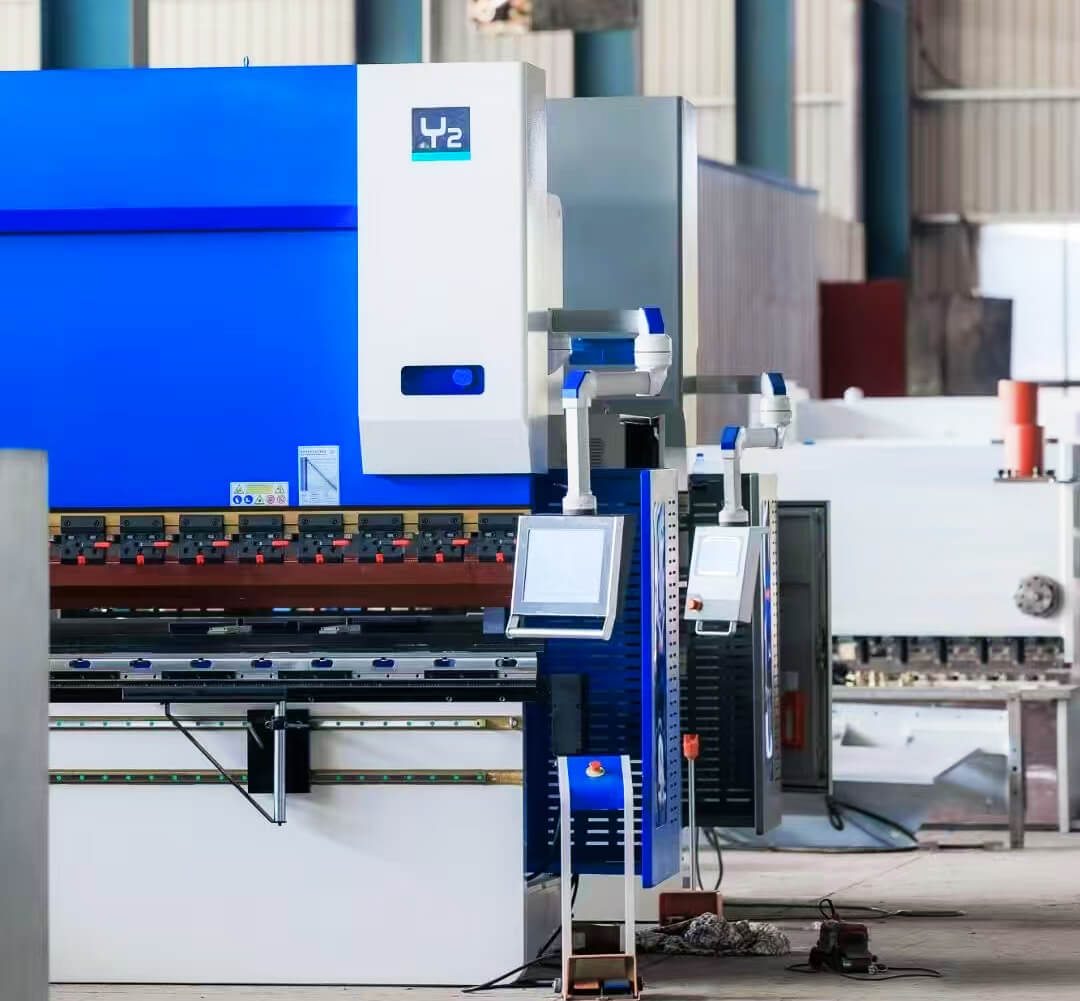
What is a Back Gauge on a Press Brake? A Press Brake back gauge is a component used in a CNC press brake machine to high precise position and align workpieces for accurate bends.The back measuring instrument consists of a series of press brake back stop fingers and blocks, which can be adjusted to the desired position. It’s a positioning system that accurately locates the workpiece under the bending tools along the back edge of the machine. While the tonnage provides the force, the backgauge system determines the accuracy, repeatability, and mass production speed .
The CNC press brake back gauge retrofit can ensure the bends with precision and consistent crossing of the length of a metal sheet (X axis).
How does the press brake back gauge work?
A modern CNC back gauge for press brake is a complex assembly of digital servo drives, beams, high-precision ball screws, fingers, and linear guide rails. when the press brake operator inputs a program,the press brake operators can adjust the position of the press brake back stops to determine the desired bend angle and length. When a piece of sheet metal is placed against the backgauge and the ram of the press brake descends, the back gauge for the press brake moves along one, two, or even several axes with the goal of positioning precisely where it needs to be for the forming process.
As the ram descends to form the bending angle, the press brake back gauge ensures the flange length is consistent to within 0.01mm. This synchronization is what allows for high-volume production with zero manual measuring. The metal is bent at the specified location, guided by the back gauge’s positioning.
Understanding the press brake back gauge Axis: X, R, and Z Defined
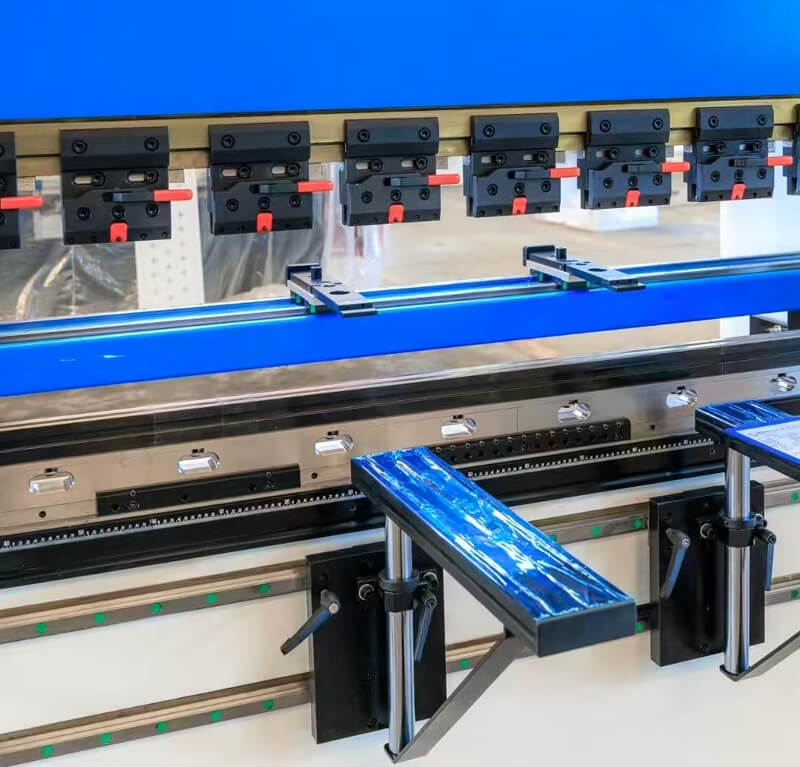
The Press brake is equipped with CNC back gauge fingers for accurate positioning on the workpiece. The type of press brake backstops and number of axes can be adapted to the type of process, part size, and number of working stations. and the precision of the workpiece determines the number of axes required by the press brake.
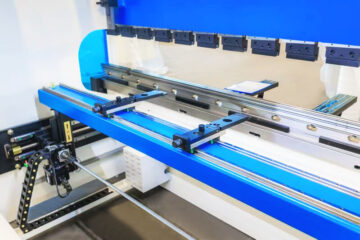
To handle complex profiles, press brake CNC back gauges move along multiple axes. In industry standards, Y1/Y2 always refers to the ram; backgauge axes. Standard Multiple axes press brake configuration includes X, Y, and R axes. and is equipped with 2 manual backstops for Z-axis-press brake back gauge fingers.
X-Axis (Foundation Horizontal Movement): As the primary positioning axis, the X-axis moves back and forth to define the flange length. The stroke of the X-axis determines the maximum depth of your bend.
Y1/Y2-axes Left/Right stop finger up and down moving axis ( Cylinder/Ram Depth )
R-Axis (Vertical Movement – The Efficiency Booster): The R-axis controls the vertical height of the backgauge fingers.In a high-volume production run with different flange heights, the R-axis automatically lifts or lowers the fingers. This prevents the workpiece from crashing into the gauge, ensuring a smooth manufacturing process without operator intervention.
- Automatic Clearance: When dealing with complex profiles that have downward-facing flanges, the R-axis automatically adjusts to avoid collisions.
- Stage Bending: It allows the use of high-low die combinations in a single setup. By automating the height adjustment, you eliminate the need for the operator to stop and manually reset the gauge, saving approximately 40% in secondary setup time.
Z1/Z2 Axes (Lateral Movement – Multi-Station Mastery): The Z-axes move the fingers left and right across the bending machine bed. This is essential for Stage Bending (multi-station setups). Instead of the operator moving the workpiece and manually re-aligning fingers, the CNC system shifts the Z-axes instantly. This is a game-changer for asymmetrical parts and complex production runs, drastically reducing workpiece handling.
- Efficiency Impact: A 4-axis (X, R, Z1, Z2) or 6-axis (adding X1, X2) system can reduce setup time by up to 50% compared to manual Z-axis adjustment, allowing for complex production runs without stopping the machine to move fingers by hand.
- The press brake back gauge fingers determine the bending accuracy of the workpiece. The more complex the workpiece is, the more axes are required for the rear stopper. you can DIY CNC back gauge for press brake to increase productivity.
- There will be a maximum of 6 shafts on the back gauge for press brake, which will have different variants. Each press brake axis has an independent drive motor to ensure accurate positioning.

The ROI of Precision: Standard vs. High-Performance Configurations
The press brake can be equipped with two main CNC controlled backgauge models. they are synonymous with robustness, accuracy, and speed. Movements are carried out through expandable and flexible digital servo motor drives. Motors and drivers are manufactured by Electric Works.
The complexity of your workpiece determines the number of axes required:
-
Basic 2-Axis: Controls X (depth) and Y (ram). Fingers are moved manually for height and width.
-
Standard 4-Axis (X, R, Z1, Z2): The industry “sweet spot” for most custom fabricating shops. It handles almost all complex bending scenarios automatically.
-
Advanced 6-Axis (X1, X2, R1, R2, Z1, Z2): Allows the two fingers to move independently in all directions. This is the ultimate solution for tapered bending and high-speed metal fabrication of irregular shapes.
Efficiency Benchmark: Manual vs. CNC-Controlled Systems
| Configuration | Axes Breakdown | Best For | bending Cycle Time Impact |
| Basic / Manual | X-axis Only | Simple, single-bend parts. | Slow: Requires manual finger adjustment for every new part. |
| Standard (4-Axis) | X, R, Z1, Z2 | Most custom fabricating & multi-bend profiles. | Fast: Saves ~40% setup time by automating finger height and position. |
| High-Performance (6-Axis) | X1/X2, R1/R2, Z1/Z2 | Tapered bending & complex asymmetrical shapes. | Elite: Independent finger movement eliminates jigs and manual resets. |
How to align back gauge on press brake?
To maintain bending accuracy, periodic press brake backgauge calibration block is mandatory. A misaligned press brake back gauge leads to “tapered bends” where one end of the part is longer than the other.
Operational Excellence: Alignment and Calibration
The press brake back gauge is a main system for accurate and repeatable sheet metal bending. Press Brake Back gauge calibration is mainly for maintaining the accuracy of the press brake and ensuring consistent results during the working time. The process includes checking and adjusting the various components of the back gauge to ensure function correctly and aligns properly. Aligning the back gauge for press brake has the following steps:
- Verify the accuracy of the backgauge: Use a calibrated block to check the distance between the die center and the stop finger.
- Clean the back gauge and bed: Wipe down the linear guide rails and ball screws. Metal dust is the #1 enemy of positioning accuracy.
- Adjust the position of the backgauge: Ensure the backgauge beam is perfectly parallel to the press brake bed.
- Zero-Point Calibration: Use the CNC control (e.g., Delem or ESA) to re-home the axes and verify the digital readout matches the physical measurement.
Conclusion: How to Choose the Right Backgauge for Your Shop?
When it’s time to upgrade your bending applications, remember that the best press brake back gauge system isn’t necessarily the one with the most axes—it’s the one that aligns with your specific production needs.
-
For Simple, High-Volume Parts: A standard 2-axis or 4-axis system is often sufficient to maintain high production speeds while keeping equipment costs low.
-
For Complex, Multi-Station Work: Investing in a 4-axis (X, R, Z1, Z2) setup is the “sweet spot” for most custom fabricating shops, as it significantly reduces manual intervention.
-
For High-Precision Geometries: If your workflow involves tapered bending or irregular shapes, a 6-axis system is a vital investment that will set your shop apart from the competition.
Not sure if a 4-axis or 6-axis system is right for your materials? Our engineering team is ready to provide a customized backgauge system recommendation based on your specific drawings and production goals.
[Contact JSTMT Engineers Today for a Technical Consultation]
Engineering Resources for Operational Excellence
To help you achieve the highest standards of precision and efficiency in your metal fabrication shop, our engineering team recommends exploring these essential technical guides:
-
Press Brake Tonnage Guide & Calculation Chart – Learn how to calculate the correct bending force to maintain the long-term accuracy of your press brake back gauge and machine frame.
-
How to Calculate V-Die Opening – A practical guide to selecting the right lower die width, ensuring your R-axis height and finger positions are perfectly calibrated.
-
High-Performance Press Brake Machines – Explore our full range of CNC-controlled bending solutions, from 4-axis to 6-axis configurations, designed for complex industrial applications.

Leave a Reply