

Industrial Shear Blade Applications
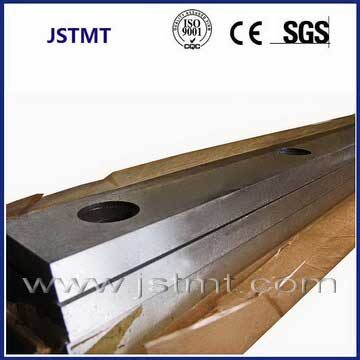
JSTMT replacement shear blades are designed for different metal-cutting requirements across sheet metal fabrication, steel processing, and heavy industrial applications. Blade geometry, cutting clearance, and tool steel grades—including 9CrSi, 6CrW2Si, D2/SKD11, H13, and Cr12MoV—are selected according to the material type, plate thickness, tensile strength, and machine specifications to achieve clean, consistent cuts and reliable blade service life.
Sheet & Plate Blanking (Mild & Carbon Steel)
Precision shearing of structural carbon plates and mild steel blanks using 9CrSi or Cr12MoV blades.
- Structural steel fabrication
- Heavy machinery base plates
- General job shop blanking
Stainless Steel & Non-Ferrous Metal Cutting
High-wear-resistance shearing of 304/316 stainless steel, aluminum, and copper sheets using D2 / SKD11 blades.
- Electrical enclosures & cabinets
- Elevator panels & architectural trim
- HVAC ducting & kitchen equipment
Heavy-Duty Plate & High-Impact Shearing
Shock-resistant cutting of thick alloy plates and structural steel blanks using 6CrW2Si or H13 blades.
- Shipbuilding & marine plates
- Heavy construction & mining machinery
- Automotive chassis & structural frames
🔧 Machine Compatibility & Precision Customization
Blade selection depends on the material being cut, its thickness and strength, the required cutting quality, and the shearing machine design. JSTMT supplies standard and fully customized replacement shear blades compatible with major shearing machine brands:
Compatible Shearing Machine Brands:
Durma
Amada
LVD
Accurpress
Cincinnati
Custom / Homemade Shears
Amada
LVD
Accurpress
Cincinnati
Custom / Homemade Shears
👉 How to Request the Right Replacement Blade?
Please provide: 1 machine brand and model, 2 blade dimensions(length × width × thickness), 3 material grade (SKD11/H13/D2), 4 typical cutting thickness, Our engineering team will match the exact specifications and recommend the optimal material and edge design
Shear Blade Material & Hardness Selection Guide
Selecting the right tool steel grade and heat-treatment hardness prevents edge chipping and maximizes cutting life across different sheet thicknesses:
| Tool Steel Grade | Hardness (HRC) | Recommended Plate Thickness & Material | Core Performance Advantage |
|---|---|---|---|
| SKD11 / AISI D2 | HRC 58–62 | 0.5mm – 8mm Stainless Steel & High-Tensile Sheet | Ultra-high wear resistance and edge retention for high-volume precision shearing. |
| 6CrW2Si | HRC 54–58 | 6mm – 16mm Medium-to-Thick Carbon & Alloy Plates | Balanced toughness and hardness; resists edge chipping under heavy impact loads. |
| H13 (4Cr5MoSiV1) | HRC 52–56 | 12mm – 25mm+ Heavy Plate & Hot Shearing | Superior shock resistance and thermal stability for heavy-duty plate shears. |
| 9CrSi / Cr12MoV | HRC 56–60 | 1mm – 6mm Mild Steel, Aluminum & Copper | Cost-effective general-purpose tool steel for standard workshop blanking. |
Features & Benefits of Our Replacement Shear Blades
| Feature | Benefit |
|---|---|
| Wear-Resistant Tool Steels | SKD11, 6CrW2Si, H13, D2, 9CrSi, and Cr12MoV options matched to cutting conditions. |
| Precision Grinding | Controlled parallelism (≤ ±0.01 mm) for consistent cut quality across the full length. |
| Furnace & Vacuum Heat Treatment | Controlled-atmosphere furnace heat treatment for standard runs and vacuum heat treatment for high-alloy steels (HRC 52–62), ensuring uniform hardness and zero decarburization. |
| Multiple Cutting Edges | 2-edge design for swing-beam shears · 4-edge design for guillotine shears. |
| Custom Solutions | Exact dimensions, hole patterns, and edge configurations available. |
Why Choose JSTMT for Industrial Metal Shear Blades?
JSTMT has been in the Sheet Metal Fabrication Industry since 1985, has experience in sheet metal machinery manufacturing and industrial tooling supply.
- OEM & Universal Compatibility: Precision-engineered replacement blades fully compatible with major global brand shearers, including Durma, Amada, LVD, Accurpress, and Cincinnati.
- Engineering & Metallurgy Customization: Our engineering team optimizes blade geometry, edge profiles, and heat-treatment hardness (HRC) tailored to your specific sheet material, plate thickness, and cutting volume.
- Strict Quality & Tolerance Control: Every blade undergoes precision grinding and furnace or vacuum heat treatment, achieving strict parallelism tolerances ( <±0.01mm) and heat-number material traceability.
- Direct Industrial Shear Blade Manufacturer : As a primary OEM manufacturer, we offer full technical support, transparent lead times, and global export compliance across 50+ countries.
Contact our engineering team today for a custom quote on high-quality plate shear blades!
What is industrial shear blade sharpening and material?
Sharpen or replace your shear knives for maximum wear resistance and impact strength. when hydraulic metal stomp shears blade sharpening is tough, it can be surface ground to the same precision tolerances to maintain a high level of productivity and ensure the finest cut quality.
The shear knife blades are made of special steel alloy, with full heat treated through the toughest conditions. The plate shear blade material can be SKD11, D2, or 6CrW2Si. Our blades are available in two-edge, and four cutting edges. We have manufactured blades for many shear brands: Durma, Amada, LVD, Accurpress, and Cincinnati. We offer complete designs for unique, obsolete, as well as custom designs for homemade shears. we offer ironworker shear blades and replacement shear blades.
How Metal Shear Blades Work?
Metal shear blades operate by applying high shear force between a top moving blade and a fixed lower blade set at a relative angle. As the upper blade moves past the lower blade set (mounted on the blade holder) , the sheet metal material separates along the cutting line.
Three critical factors determine cutting performance:
- Blade Clearance: The gap between the upper and lower blades must be appropriate for the material type and cutting thickness. Incorrect clearance can increase burrs, distortion, and blade wear.
- Blade Angle(rake angle): Influences cutting force and material deformation. The optimal angle depends on machine design and cutting application.
- Blade Condition and Material:Sharp edges, correct alignment and the right tool steel grade ensure consistent cut quality and longer service life.
For best results, always confirm the shearing machine type, blade dimensions, material being cut and required thickness before selecting a metal shear replacement blades.
Technical Resources & Troubleshooting Guides
To ensure the longest lifespan for your shear blades, correct setup and material selection are critical. Browse our technical library below to optimize your shearing production:
- Setup Guide: Before installing new knives, ensure you set the correct gap. View our [Shear Blade Gap Clearance Chart] for Mild Steel vs. Stainless Steel.
- Material Selection: Not sure which grade to buy? We compare [9CrSi vs. 6CrW2Si vs. H13 Materials] to help you choose the longest-lasting steel for your application.
- Troubleshooting: Is your machine cutting curved or twisted parts? Read our guide on [5 Common Shearing Defects] (Twist, Bow, & Camber) and how to fix them.
- Maintenance: Wondering if you can save money by grinding old blades? Read our cost analysis on [Sharpening vs. Replacing Shear Blades].
FAQ- Frequently asked questions
The replacement shear blade is a cutting blade for the metal shear machine. It is composed of a top moving blade and a lower blade. The material is made of high chrome or high carbon steel for extended blade life. It works by clamping the material with the upper blade and the lower blades with a fixed cutting angle.
The shearing cutting blades are used for cutting steel plates into different strips with exacting tolerances. It is an important spare parts in the shearing machine. The shear knives include a top blade and bottom blade, and can be used for cutting different materials such as mild steel, stainless steel, and aluminum.
JSTMT manufactures high-performance shear blades utilizing premium SKD11, 6CrW2Si, and H13 tool steels with precise parallelism and vacuum heat treatment for optimal cutting performance.
What Materials are Often Used for the Blades of the Shears
Shearing( die cutting) is a process that cuts stock without the formation of metal chips. If the cutting blades are straight the process is called shearing; if the cutting blades are curved then they are shearing-type operations.
The Hydraulic metal cutting shear is a kind of machine that uses the moving upper blade and fixed lower blade to apply shear force to metal plates of various thicknesses by using reasonable blade clearance, to break and separate the plates according to the required size.
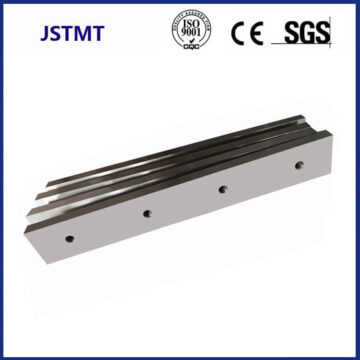
The replacement shear blades are available in two-edge for swing beam shear and four-edge for guillotine shear. and the material of the shearing machine blade parts is hardened to ensure consistent hardness; The hardening and tempering furnace can handle shear blades up to 16 feet in length.
- 2-edge shear knife. It is used for swing beam shear with two sided flat and two sided inclinable edge. The movement route is a circular line.
- 4-edge shear knife. It is used for a guillotine shear. The movement route is a straight line.


Catalogue