

How It works
Understanding the Hydraulic System and Working Principle
A CNC press brake bends sheet metal by applying controlled hydraulic force through matched punch and die tooling.The CNC system synchronizes ram movement, backgauge positioning, and bending pressure,and tooling precision to achieve accurate sheet metal bending results.
Main Components
♦ Hydraulic system
♦ Ram and frame
♦ CNC backgauge
♦ Press brake tooling
♦ Foot pedal control
Key Performance Factors
♦ Bending tonnage
♦ Tooling precision
♦ Material springback
♦ Hydraulic synchronization
Why Correct Tonnage Matters
T=V1.42×S2×L
Incorrect tonnage selection for the metal press brakes may result in poor bend accuracy, tooling damage, or machine overload.
CNC & Servo Electric Press Brake Technology
Modern CNC press brake systems improve bending efficiency through automated programming, multi-axis synchronization, and precision backgauge control.
Compared with conventional hydraulic systems, servo electric press brakes provide:
♦ higher positioning accuracy
♦ faster cycle times
♦ lower energy consumption
♦ reduced maintenance requirements
Common Applications
♦ stainless steel fabrication
♦ electrical enclosures
♦ elevator panels
♦ precision sheet metal parts
Need assistance selecting the correct tonnage, tooling, or controller configuration? JSTMT engineering specialists can recommend suitable press brake solutions for your production requirements.
CNC Press Brake Machines Advantages
The CNC metal brakes suit complex working pieces and mass productions with high efficiency.
Standard Configuration

Sevo Controlled Back Gauge
CNC backgauges are mechanical systems that move along one, two, or multiple axes to position a piece of metal.
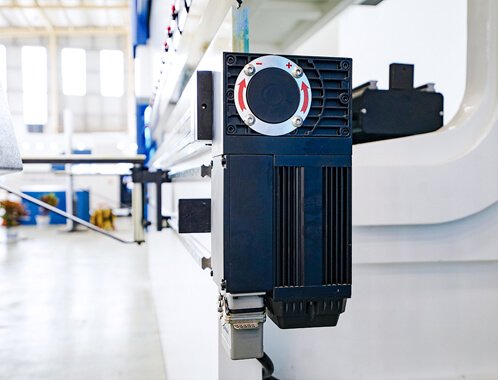
Crowning System
The compensations for the deflection can help achieve perfect bending results with equal and consistent angles along the length of the bend.
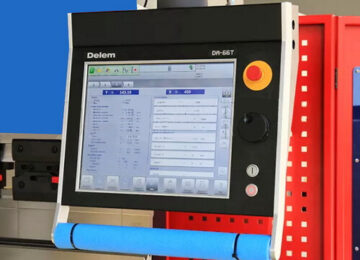
Friendly CNC Bending Controller-Delem DA66T
The efficient Delem CNC press brake retrofit optimizes the bending cycle and working precision, reduces the setup time for work steps, and enhances the batch efficiency of the bending process. Learn More...
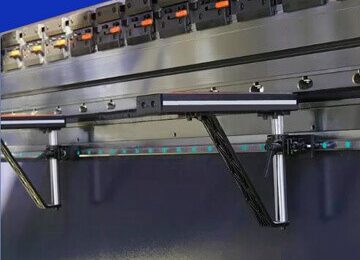
Movable Front Arm
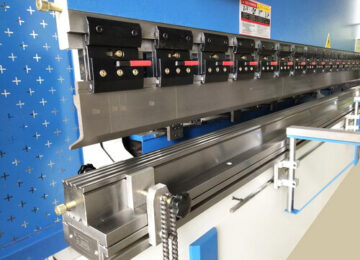
Quick Clamp
It offers solutions for swift setup and changeover times and deflection mitigation.
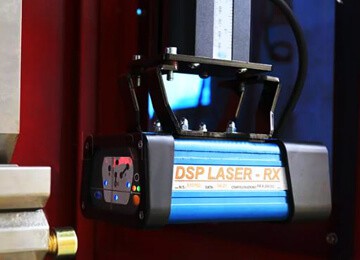
What is the laser safety on a CNC press brake?
The safety light curtains of the Sentinel protection system include a DSP modified laser safety device installed on the upper beam of the press brakes.
Engineering Highlights
| Feature | Engineering Advantages |
| CNC Control Systems | DELEM DA53T / DA66T / ESA controllers with multi-axis programming |
| Hydraulic Synchronization | Stable bending accuracy with automatic crowning compensation |
| Servo Backgauge | High-speed positioning with repeatable accuracy |
| Custom Tooling | Multi-V dies and custom punch tooling for complex bending profiles |
| Global Technical Support | Remote diagnostics and commissioning assistance |
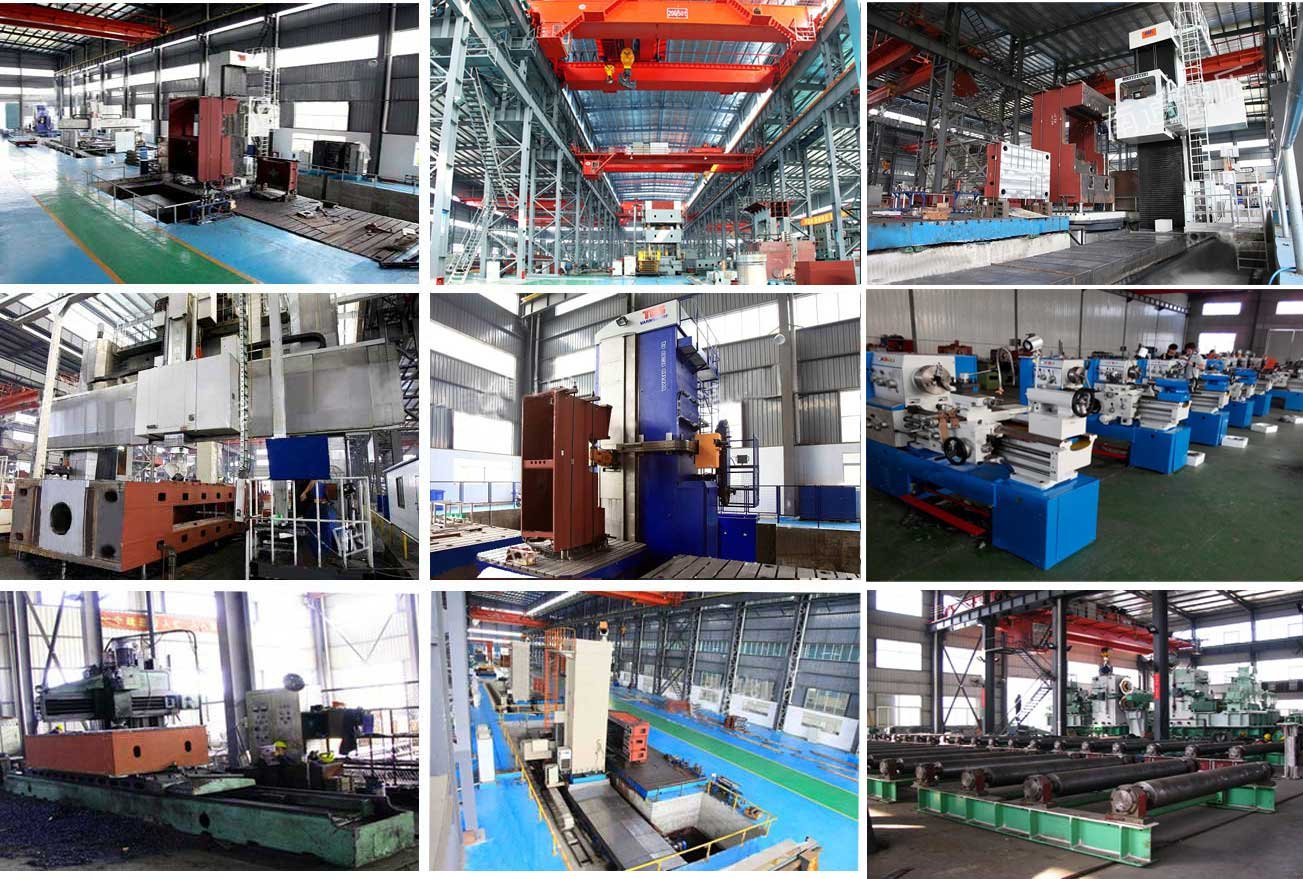
Applications
Power Cabinets

Pole Fabrication

Elevator Industry

Technical Resources & Buying Guides
Optimizing your manufacturing process requires more than just high-quality hardware. To help your press brake operators achieve the best results with high precision, our engineering team has compiled these essential technical resources:
-
Technical Reference: What is a Press Brake? – A deep dive into the working principles of press brake machines, from the hydraulic system to the foot pedal controls.
-
Critical Safety: Press Brake Tonnage Guide – Learn how to accurately calculate bending force for various sheet metal thicknesses to prevent damage to your machined tooling.
-
Expert Selection: Press Brake Tooling Types – A comprehensive guide to choosing the proper tool for specific bending applications, including custom and style tooling solutions.
- Practical Tooling: How to Calculate V-Die Opening – A must-read for daily operations. Learn the precise formula for selecting the correct V-die width based on your sheet metal thickness to ensure a perfect metal bend.
FAQ- Engineering Quick Answer
Tonnage depends on material type, thickness, and V-die opening. For example, bending 6mm mild steel with an 8t V-die typically requires approximately 50-60 tons per meter.
A Guide to Choosing the Right Press Brake Tonnage
Servo-electric models offer 30% higher energy efficiency and faster cycle times for thin materials, while hydraulic models are better suited for heavy-duty, high-tonnage applications.
Modern CNC press brakes can achieve repeatability up to ±0.01 mm depending on machine configuration, tooling quality, and material consistency.
Safe hydraulic press brake operation includes correct V-die selection, stroke testing, backgauge alignment verification, avoiding overload conditions, using safety guards, and proper pedal control. Read our full operation guide for detailed safety procedures.
6 Operation Rules for the Hydraulic Press Brake
NC press brakes are best for simple, repetitive bending with manual adjustments, while CNC press brakes are ideal for complex, multi-step parts requiring high precision and automatic angle calculation. CNC machines significantly reduce setup time for diverse batches. [Check our comparison guide].
NC vs CNC Press Brake Which Machine Suits Your Workshop Best
Programming a CNC press brake involves selecting material type, thickness, tooling, bend angle, and bending sequence through the CNC controller. Advanced systems automatically calculate bend allowances, compensate for springback, and optimize multi-step bending operations for higher precision and productivity.
How to program a cnc press brake
Catalogue