

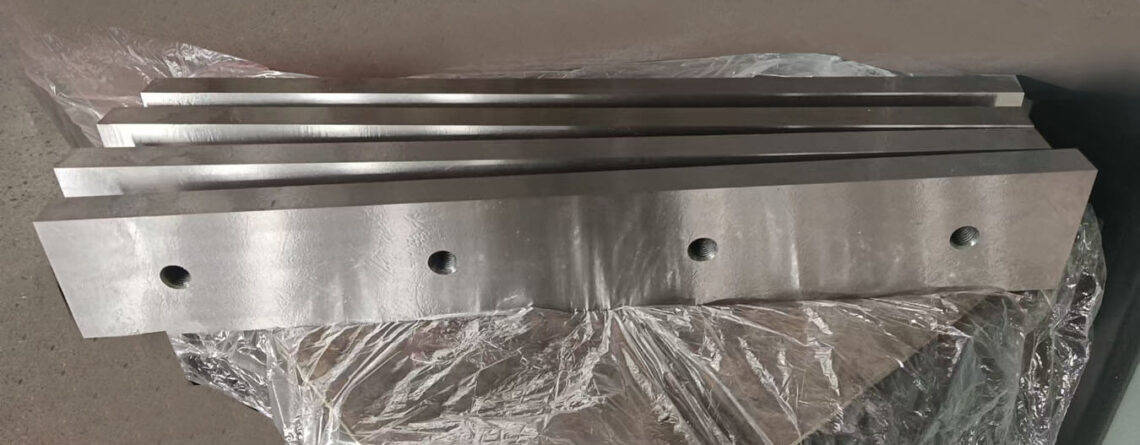
Top 5 Advantages LD Material Shear Blades
What is LC Material of the Shearing Machine Blades?
LD material (7Cr7Mo2V2Si) is a high-strength, high-toughness cold-work die steel that offers significant advantages over traditional materials like 9CrSi and H13. It is a high-performance alloy tool steel specifically engineered for heavy-duty shearing machine blades.
While 9CrSi is a common low-alloy tool steel used for basic cutting tools due to its high hardenability, LD provides superior performance in demanding industrial applications. Such as for stainless steel, medium to thick plates, and general scrap cutting, providing good performance in demanding applications.
The advantages of LD material in manufacturing shearing blades
Compared to traditional, commonly used materials such as Cr12MoV, 9CrSi, and H13, the advantages of LD material are primarily reflected in the following aspects, with its core being an outstanding balance between toughness and wear resistance.
1. Excellent impact toughness
Performance: This is the most outstanding advantage of LD material. When shearing thick plates, high-strength plates, or plates with hard particles or weld spatter, the cutting edge is less prone to chipping or breaking.
Value: It enhances the safety and reliability of the shearing blade under harsh working conditions, reducing unplanned downtime and replacements caused by unexpected events.
2. High wear resistance
Performance: Containing a significant amount of vanadium (V) and molybdenum (Mo) carbides, it exhibits excellent resistance to abrasive wear after heat treatment (with hardness reaching HRC 58-62).
Value: Under prolonged continuous shearing, the blade dulls slowly and maintains sharpness for a longer period, ensuring an extended single-grinding lifespan and more stable shearing quality.
3. Precision & Clean Cuts
Delivers extremely straight, clean cuts with minimal burrs, improving part quality and reducing the need for secondary finishing.
4. Excellent strength-toughness synergy
Performance: The so-called matrix steel characteristic refers to its composition being close to that of high-speed steel, featuring a hardened matrix that reduces coarse eutectic carbides and results in a more uniform microstructure.
Value: This enables the blade to withstand higher shear stress and impact loads, making it particularly suitable for shearing thick plates with large gaps.
5.Minimal Heat Treatment Distortion:
LD steel exhibits small distortion during heat treatment, which helps maintain the precise shape and dimensions of the blade, crucial for accurate cuts.
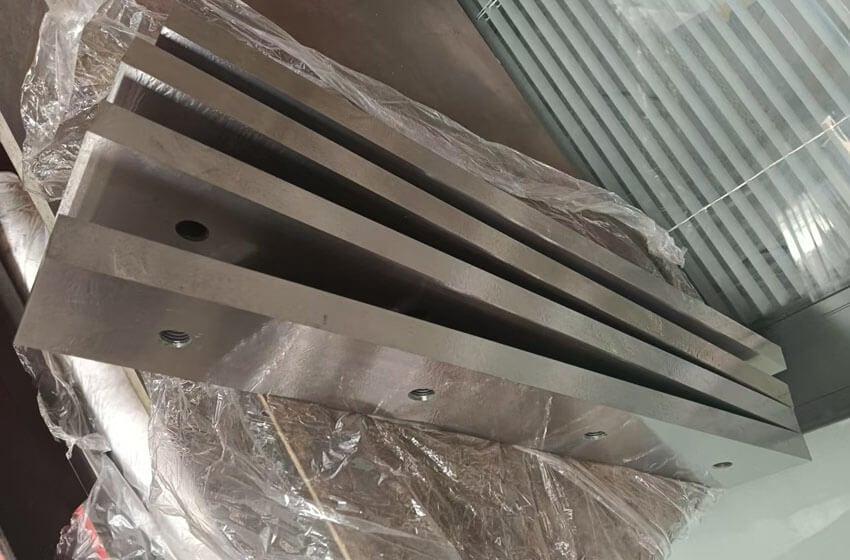
Conclusion:
Key advantages of LD material include:
- High Resistance to Annealing: Unlike standard steels, LD maintains its structural integrity and hardness even under the thermal stress of continuous shearing.
- Optimized Hardness: It achieves a high hardness (HRC 58-62) without the brittleness typically found in high-carbon steels.
- Superior Service Life: The material composition directly improves wear resistance and processing results compared to basic alloys.
Note: While “H13” also refers to automotive lighting, in the context of blade manufacturing, LD outperforms H13 tool steel in impact-heavy environments.
Would you like me to compare the specific chemical compositions of LD and Cr12MoV?

Leave a Reply